How to Redesign a Bedroom Without Replacing the Bed
Keep your bed and redesign the room around it with a practical order for bedding, nightstands, lamps, rug, curtains, art, wall color, and verification.

To redesign a bedroom without replacing the bed, make the bed the fixed anchor and change the layers that frame it. Record the frame's color, material, silhouette, size, position, and orientation; build a palette around those facts; then resolve bedding, nightstands, lamps, rug, curtains, art, and wall color in that order. Preview the full direction before buying, but approve it with measurements, samples, current product details, and installation checks.
| Layer | Decision | Verify in the room |
|---|---|---|
| Bed | What exact frame must stay? | Shape, material, condition, dimensions, position |
| Bedding | Quiet support or intentional contrast? | Fabric, care, warmth, true color |
| Nightstands and lamps | What must each side do? | Height, reach, outlets, shade and glare |
| Rug | What footprint grounds the bed? | Measured edges, doors, vents, cleaning |
| Curtains | How much light and privacy are needed? | Operation, length, radiator and hardware |
| Art and wall color | How should the bed wall read as one composition? | Samples, full-size templates, mounting |
1. Record the bed you are actually keeping
Photograph the bed in daylight and ordinary evening light. Note the frame material, visible undertone, headboard shape, upholstery texture, leg or base style, mattress height, and visual weight. Record wear, cleaning restrictions, storage needs, and anything that cannot be covered. A tall dark wood bed needs a different balance than a low ivory upholstered frame.
Measure the frame rather than relying on the nominal mattress size. Include the widest and longest points, headboard height, floor clearance, nearby outlets, windows, doors, vents, and the paths used on both sides. If the bed position can change, test the route and sightline before styling; if it cannot, treat its wall as the composition to solve.
For the broader upload-to-plan sequence, use the AI bedroom design from a photo guide. This guide begins after the bed has become the non-negotiable anchor.
2. Build a palette from the frame outward
Place bedding, rug, curtain, wood, metal, and paint samples beside the frame instead of choosing them in isolation. Look for a relationship: harmonious undertones, deliberate light-dark contrast, or a repeated material. If an ivory frame turns yellow beside cool gray, test warmer stone, taupe, olive, walnut, or aged brass before deciding that the bed is the problem.

3. Let the bedding establish the new direction
Use the largest bedding layer to establish the room's temperature and contrast. Crisp white can sharpen a textured neutral frame; warm flax or taupe can soften it; one controlled pattern can connect the frame to the rug or art. Choose for sleep comfort, laundering, pets, allergies, and climate as well as appearance.
Build only the layers you will use: sheets, a duvet or quilt, perhaps a folded coverlet or throw, sleeping pillows, and a restrained number of decorative pillows. Vary weave and scale rather than stacking many similar beige fabrics. Make the bed normally before judging the palette; a styled photograph should not require an impractical daily setup.
4. Choose nightstands by bedside function
List what each side needs to hold: a lamp, water, book, glasses, phone, medication, or closed storage. Nightstands do not have to match, but their tops should relate comfortably to the mattress and their visual weights should balance the bed. A compact table and a small chest can work together when a repeated wood, hardware finish, or lamp shape connects them.
Template each footprint and open every drawer, closet door, and window. Check the delivery route and confirm current product dimensions. Avoid choosing a nightstand only because it fills a generated image; the depicted object may not be a real product and its apparent scale may be wrong.
5. Give the bed useful light on both sides
Plan ambient light for the room and task light for reading, dressing, or winding down. Matching lamps can create calm symmetry, while a wall light on one side and a table lamp on the other can work when their brightness, shade, and visual weight feel related. Map switches, outlets, cords, and seated sightlines before choosing fixtures.
Test bulb appearance against the frame, bedding, rug, and paint samples after dark. Shield bright bulbs from direct view and keep controls reachable without crossing the room. Plug-in fixtures can be flexible; new hardwiring and permanent electrical changes need appropriate professional review.
6. Size the rug for the whole bed zone
Decide where softness is useful when stepping out of bed and where the room needs visual grounding. Tape the rug's full outline under the actual frame. Compare a larger placement that includes more of the bed zone with a smaller placement beginning farther down the frame; there is no useful universal answer without the room dimensions.
Check exposed edges from the doorway, nightstand relationships, doors, vents, floor transitions, cleaning access, pile, and care. Use the preview to compare visual coverage, then use measurements and a real sample to select a product. A generated rug pattern, color, or border is not a purchase specification.
7. Make curtains solve light and composition
Treat window coverings as both functional equipment and a large textile plane. Decide the required privacy, daylight control, and nighttime darkness before choosing color. Curtains can quietly repeat the wall, relate to the bedding, or add controlled contrast, but they still need to clear handles, radiators, vents, furniture, and the floor.
Measure every window and inspect existing hardware. Test fabric beside the bed in daylight and with lamps on. If the current curtains work, changing only the bedding, rug, or wall color may be enough; keeping a useful layer is better than replacing it to complete a shopping list.
8. Finish the bed wall with art and color
View the headboard, lamps, nightstands, wall color, and art as one elevation. Use paper templates for proposed art and judge the empty wall around the grouping. One substantial piece, a balanced pair, or a quieter unfilled wall can all work; many small pieces are not automatically more finished.
Paint large removable samples and view them beside the frame, bedding, and curtains throughout the day. Before mounting anything above a bed, verify wall construction, hardware, object weight, local conditions, and placement. A concept image cannot approve mounting safety.
9. Audit an exact-bed before-and-after
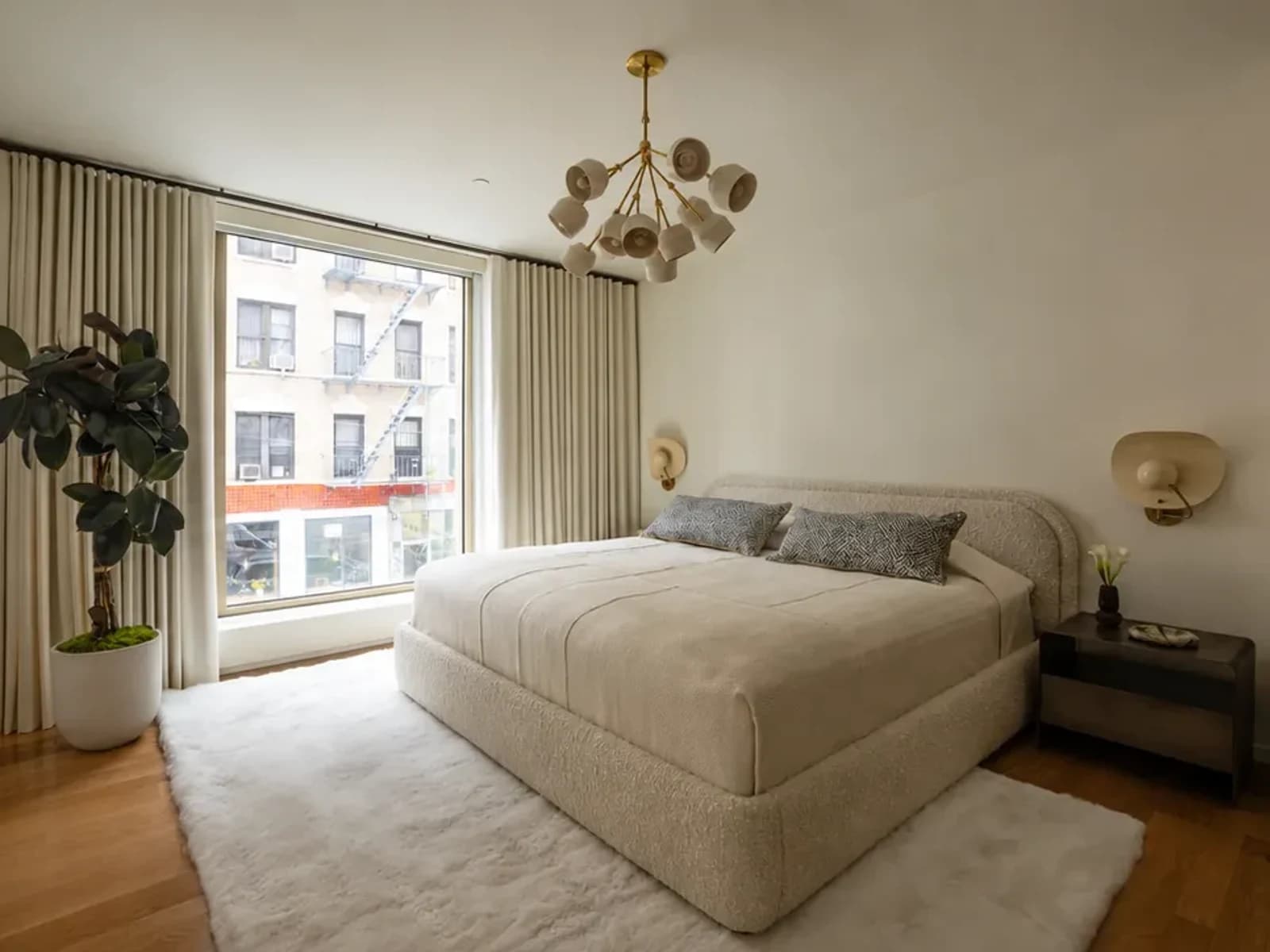 before
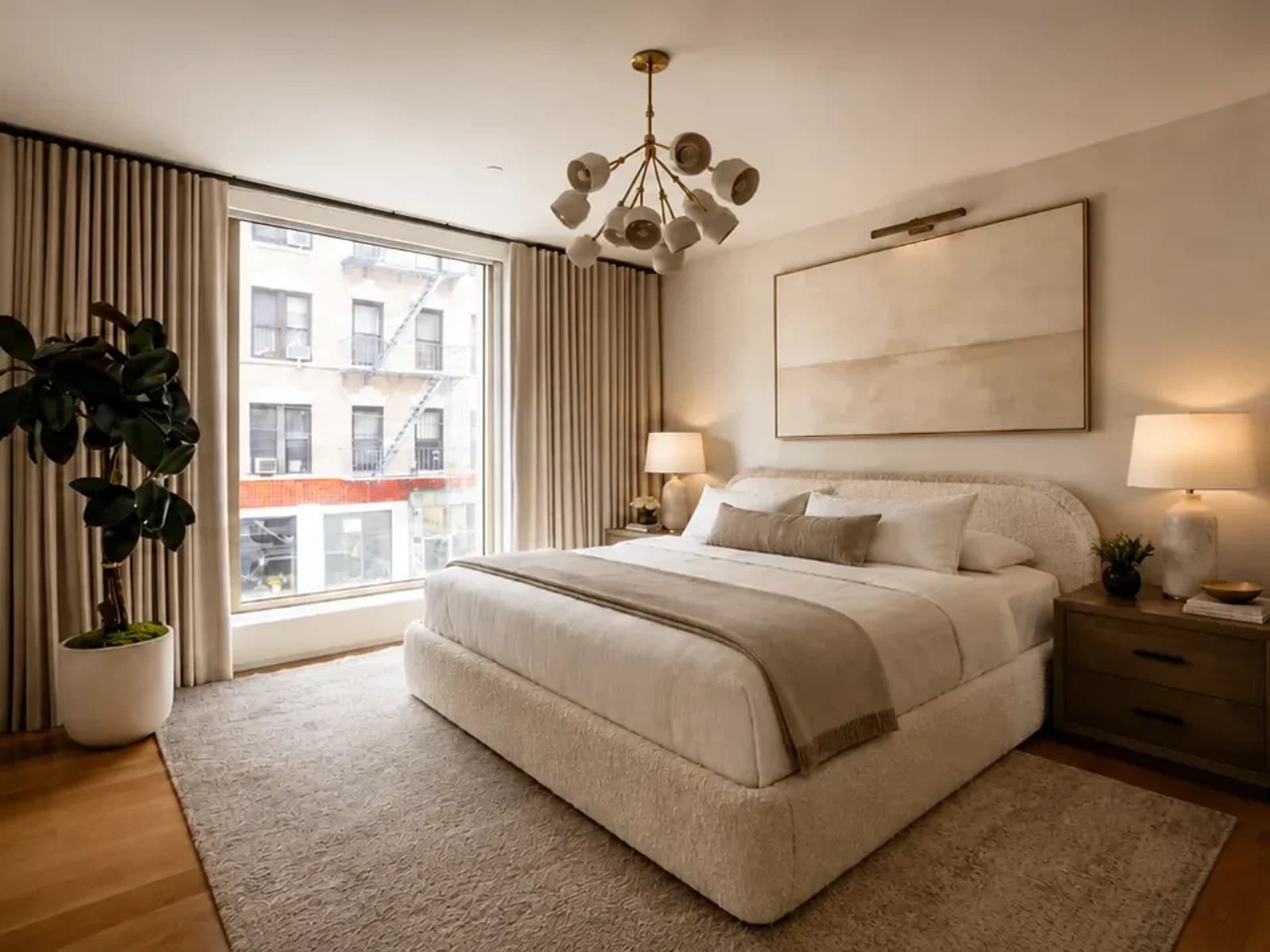 after
afterWhat stayed
The ivory upholstered frame and curved headboard remain recognizable, along with the large window, curtains, wood floor, chandelier, plant, room shell, camera relationship, and broad bed position. Those anchors make the comparison useful as a redesign of the same bedroom.
What changed
The concept tests layered white and taupe bedding, paired wood nightstands, warmer lamps, a quieter patterned rug, one large artwork, and restrained bedside decor. These are visual directions, not evidence of purchased products or completed installation.
What to verify
Compare the frame's shape, material, scale, position, and orientation with the source. Then measure nightstand and rug footprints, walking paths, windows, outlets, drawer clearance, and delivery access. Confirm real fabrics, paint, products, returns, mounting, electrical work, and furniture stability before acting.
Where children live or visit, follow current U.S. Consumer Product Safety Commission tip-over guidance for relevant furniture and televisions; follow product instructions and verify the wall and anchoring method.
If the bed is only one of several pieces that must remain, use the broader guide to keep existing furniture in an AI redesign.
A reusable keep-bed prompt
For shorter first-pass and correction language, adapt the AI room design prompt library. Change one category per revision so preservation drift is easier to spot.
Shop in dependency order
- Measure and photograph the bed frame, room shell, windows, outlets, and clear paths.
- Approve one palette with physical bedding, rug, curtain, wood, metal, and paint samples.
- Choose the largest useful bedding layers before decorative pillows and throws.
- Template nightstands and rug; check drawers, doors, reach, vents, and delivery.
- Map lamps to actual outlets and any qualified electrical work.
- Template art and test wall color only after textiles and lighting are stable.
- Recheck current dimensions, materials, stock, delivery, care, and returns before ordering.
Use the companion guide on AI interior design accuracy to separate a persuasive bedroom image from verified scale, products, materials, and feasibility.
Common keep-bed mistakes
- Buying decorative pillows before choosing the bedding and rug direction.
- Trying to match the bed frame exactly instead of building intentional contrast or harmony.
- Choosing nightstands for symmetry while ignoring storage, outlets, and reach.
- Reading rug size or furniture clearance directly from a generated image.
- Selecting lamps without testing glare, controls, and nighttime color.
- Hanging art above the bed without verifying wall construction and hardware.
- Assuming depicted furniture, fabric, paint, or dimensions are exact products or specifications.
Frequently Asked Questions
Make the existing bed feel intentional
A good bedroom redesign does not hide the bed. It gives the frame a clear role, uses bedding to establish the new direction, balances bedside function, grounds the bed with a measured rug, and connects curtains, art, light, and wall color back to the same palette. Preview the layers together, then approve every real decision with samples, dimensions, and current product information.
FAQ
Common questions
- Where should I start when redesigning a bedroom around an existing bed?
- Start by recording the bed frame's visible color, material, shape, size, position, and orientation. Then choose a palette and solve the rug and bedside function before buying decorative layers.
- Does new bedding need to match the bed frame?
- No. Bedding should relate to the frame through undertone, contrast, or texture, not duplicate it. Use physical fabric samples in the room because screens and generated images cannot confirm an exact material match.
- Do bedroom nightstands have to match?
- No. They can differ when their heights, visual weight, finishes, and functions feel balanced around the bed. Repeating a lamp, color, or material can create continuity.
- Should the rug go under the nightstands?
- That depends on the room and rug footprint. Test the full outline with tape and choose a placement that gives useful softness beside the bed without blocking doors, vents, or circulation. Measure before ordering.
- Can an AI bedroom preview keep my exact bed?
- It can use the bed as a preservation constraint, but compare every result with the source. Verify the frame's shape, color, scale, position, and orientation, and treat the image as a concept rather than proof of products or exact fit.
Keep exploring
Related reading
Bedroom Ideas
See the Same Bedroom in Six Interior Design Styles
Bedroom Ideas
Coastal Bedroom Ideas Without the Beach-House Clichés
Bedroom Ideas
Moody Bedroom Ideas That Feel Rich, Not Dark and Heavy
Bedroom Ideas
Warm Modern Bedroom Ideas That Feel Elevated, Not Beige
AI Room Design
AI Bedroom Design From a Photo: A Practical Step-by-Step Guide
AI Room Design
Can AI Redesign a Room While Keeping Your Existing Furniture?
AI Room Design
30 AI Room Design Prompts for More Realistic, Useful Results
AI Room Design
How Accurate Is AI Interior Design? What to Trust and What to Verify
Try Room Foundry
See a new bedroom without losing the bed.
Upload your room, identify the bed as a keep item, and preview the bedding, rug, lighting, palette, and surrounding furniture together.
Preview your bedroom free